Big news: Aaddress.in is now Address.co ✨




 +919211315848
Registered Office Compliance After Incorporation: What Are the Requirements? (Complete 2026 Checklist)
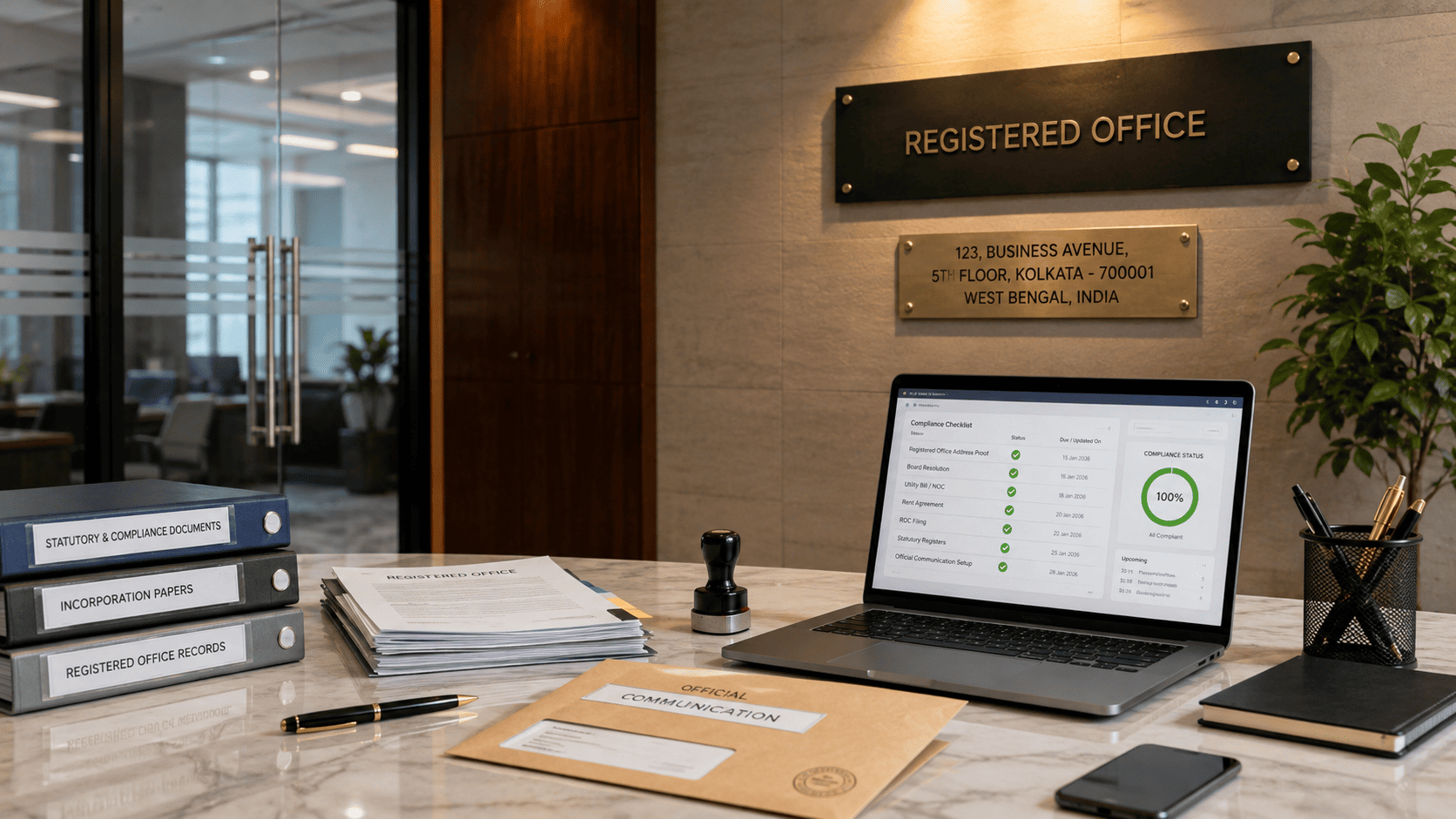
Quick Summary: After incorporation, a company’s registered office must continue to function as a valid statutory address. It should be capable of receiving and acknowledging official communications, the company should comply with applicable name and address display requirements, MCA records should remain current, and the business should be prepared for ROC verification where the law permits it. A virtual office does not remove these responsibilities.
Introduction
Receiving a Certificate of Incorporation does not end your registered-office responsibilities. The registered office is not merely an address entered during company formation; it has an ongoing statutory role.
This matters especially for founders who work remotely, use a virtual office or coworking center, move offices after incorporation, keep accounting records elsewhere, or rely on a third party to receive government correspondence.
The practical question is not simply, “Do I have a registered office?" It is, “Is my registered office still compliant and operational after incorporation?”
What Must a Registered Office Do After Incorporation?
Under Section 12 of the Companies Act, 2013, a company must have a Registered Office capable of receiving and acknowledging communications and notices addressed to it. The same section also covers verification, display requirements, address changes and physical verification in specified circumstances.
| Compliance Area | Practical Requirement | Why It Matters |
|---|---|---|
| Registered address | Maintain a valid registered office. | Official statutory address of the company |
| Receive and escalate official communications. | Reduces the risk of missed ROC, legal, or regulatory notices | |
| Name/address display | Maintain required company identification. | Section 12 compliance and verification readiness |
| MCA records | Keep registered office details current. | Avoids mismatch between actual and official address |
| Supporting documents | Keep right-to-use and property documents current. | Important for filings, KYC, and verification |
| Books and records | Maintain them at the required place or follow the process for another location. | Section 128 compliance |
| Physical verification | Keep the address genuine and identifiable. | ROC can verify in specified circumstances. |
| Agreement renewal | Maintain continuity of the right to use the premises. | Prevents an address-proof gap |
1. Keep the Registered Office Capable of Receiving Official Communication
A compliant registered office should have a reliable process for receiving and acknowledging official communications. This is particularly important when directors and employees work from other cities.
Examples of communications that may reach the address include ROC/MCA correspondence, government letters, shareholder communications, legal notices, and bank or KYC correspondence.
If you use a virtual office, confirm:
- Who receives government or legal mail at the premises?
- How quickly is the company notified?
- Are scans or photographs of the envelope/document provided?
- Can the original be collected or forwarded?
- Is there an inward-mail log or another traceable process?
- What happens when a time-sensitive notice arrives?
For a deeper treatment of notice handling, see Address.co’s guide on receiving legal notices at a virtual office address. It explains why a virtual-office mail process should be treated as a compliance function rather than a convenience feature.
2. Is a Name Board Mandatory at the Registered Office?
Section 12(3)(a) of the Companies Act requires every company to paint or affix its name and the address of its registered office and keep that information displayed on the outside of every office or place in which its business is carried on, in the manner described by the provision. The statutory wording is available on India Code.
For a company using shared or virtual premises, discuss the practical display arrangement with the provider before relying on the address for incorporation or changing the registered office. Confirm how the company will be identifiable at the premises and whether building-management restrictions apply.
3. What Company Details Should Appear on Official Communications?
Section 12 also requires specified company information to appear on business letters, billheads, letter papers, notices, and other official publications. Relevant details can include the company name, registered office address, corporate identity number, telephone and fax number if any, and email and website address if any.
This means an address change should trigger a broader information review, not just an MCA filing. Check applicable:
- Letterheads and official templates
- Contracts and notices
- Website contact/footer information
- Bank and KYC records
- Vendor/customer master records
- Other official business documents
4. Can a Virtual Office Be Used as a Registered Office?
A virtual-office arrangement can potentially provide the physical address and documentation used as a company’s registered office, but the address must still perform the statutory functions expected of a registered office. A mail-only service should not automatically be assumed to be suitable for incorporation or MCA filings.
Before choosing a provider or plan, verify whether it includes:
- Registered-office address usage in the agreement
- NOC or owner/occupant authorization where required
- Current utility/property-supporting documentation
- Official mail and courier handling
- Company identification or name-board support
- ROC/MCA verification support
- Renewal documentation and continuity of address use
Address.co’s virtual office service is designed around business-address use cases such as company registration, GST registration, and correspondence. Its company-registration document guide is also useful when preparing incorporation documentation.
5. Can ROC Physically Verify a Registered Office?
Yes. Section 12(9) permits physical verification of the registered office where the registrar has reasonable cause to believe that the company is not carrying on business or operations, subject to the prescribed process.
The MCA inserted Rule 25B of the Companies (Incorporation) Rules to prescribe the physical-verification process. The rule provides for a visit to the registered office, cross-verification of address documents, a photograph of the office, and a report recording location and visit details.
What Can ROC Check During Registered-Office Verification?
| Check | What the Company Should Keep Ready |
|---|---|
| Address match | The actual premises and MCA record should correspond, including unit/floor/building details |
| Company identification | The company should be identifiable at the location in a manner consistent with applicable requirements |
| Right-to-use documents | Current agreement, consent or other applicable occupancy documentation |
| Property-supporting documents | Utility bill or ownership/occupancy evidence where required |
| Person/premises verification | The person or provider at the location should understand the company’s legitimate address arrangement |
| Mail capability | Official correspondence should be capable of being received and escalated |
| Location evidence | Landmark and physical location should be identifiable |
| Records | Relevant records should be maintained and available as required by law |
6. Do Books of Account Have to Be Kept at the Registered Office?
Section 128 of the Companies Act states that companies shall prepare and keep books of account and other relevant books and papers at the registered office. It also permits the The board is to decide that all or any of those books will be kept at another place in India, subject to notice being filed with the Registrar within the statutory time period. The Act also permits records to be maintained in electronic mode as prescribed.
The official Companies Act, 2013 text on India Code contains Section 128. For companies keeping books at a place other than the registered office, Form AOC-5 is the prescribed notice form under the current Companies (Accounts) Rules framework.
The practical lesson for remote companies is that a virtual registered office does not mean accounting records can be kept anywhere without process. Decide where the records are maintained and complete the applicable corporate action and filing where required.
7. Keep Registered-Office Documents Current
A common compliance weakness is allowing the address agreement to expire while the MCA record continues to display the same location. The address may remain visible in MCA master data, but the company may no longer have current documentary evidence supporting its right to use the premises.
This can become important during ROC verification, bank KYC, updated company filings, lender due diligence, receipt of government correspondence, or a later registered office change.
Address.co has a dedicated guide explaining what happens when a virtual office agreement expires, including GST, MCA, banking, and mail-handling risks.
8. What Happens If the Registered Office Changes?
If the company actually changes its registered office, the change should be completed through the applicable MCA process. The procedure differs depending on whether the shift is within the same local limits, outside local limits but within the same state/ROC, across ROC jurisdiction, or from one state to another.
The official MCA instruction kit for Form INC-22 explains the supporting-document expectations for a change of registered office. Address.co’s practical guide on changing a Registered Office to a virtual office covers the common INC-22/MGT-14 workflow and documentation checklist.
Registered Office Compliance Checklist After Incorporation
Address and Documentation
- Registered office address matches MCA records
- Current right-to-use documentation is available.
- The virtual office or lease agreement has not expired.
- NOC/owner or authorized-occupant consent is available where applicable.
- Utility/property-supporting documentation is current where needed.
- Address formatting is consistent across documents
Name and Identification
- The required company name/address display has been arranged
- Reception or premises personnel can identify the company where relevant.
- Applicable company details are correct on official business communications.
Mail and Notices
- Government and legal mail can be received.
- Incoming official correspondence is monitored.
- Directors receive urgent notifications promptly.
- Mail-forwarding/contact details are current
MCA and Corporate Records
- Registered office details are current in MCA records.
- Address changes are filed when required.
- Books of account are maintained at the appropriate location, and any required notice has been filed.
- Relevant statutory/corporate records remain available as legally required.
- Directors know where official company correspondence is received.
Virtual Office Provider
- Agreement renewal date is tracked
- Registered-office use is explicitly supported by the plan.
- Verification assistance is understood.
- Updated documents can be issued when needed.
- Company identification arrangements are understood.
- Government mail handling procedure is confirmed
How to Keep a Virtual Registered Office Compliance-Ready
Step 1: Verify the MCA address.
Check the unit number, floor, building, road, locality, city, state, and PIN code against the actual premises and current documents.
Step 2: Review the agreement
Confirm that it is current, in the correct entity name, covers the correct premises, and supports Registered Office use.
Step 3: Confirm company identification
Review how the company name and registered office information are displayed or identified at the premises.
Step 4: Test the mail process
Ask what would happen if an ROC or legal notice arrived today. The process should be clear, documented, and fast.
Step 5: Review records
Confirm where books of account and other records are maintained and whether any applicable filing for another location has been completed.
Step 6: Prepare for verification
Maintain a digital compliance folder containing current address agreements, NOC/consent, utility/property documents, and key MCA filings.
Example: Private Limited Company Using a Virtual Registered Office
Suppose ABC Consulting Private Limited is incorporated with a virtual registered office in Delhi while its founders work remotely from Pune and Bengaluru. The directors do not necessarily need to work from the Delhi premises every day, but the registered office still needs to perform its statutory function.
The company should therefore:
- Keep its right-to-use agreement current
- Maintain applicable company identification at the premises
- Ensure official mail is received and escalated
- Keep MCA address information current
- Follow Section 128 requirements for books and records
- Maintain supporting documents in a compliance folder
- Stay prepared for ROC verification where applicable
Legal References Founders Should Know
Section 12, Companies Act, 2013: Registered Office requirements, receiving communications, display, address changes, and physical verification.
Rule 25B, Companies (Incorporation) Rules: Prescribed process for physical verification of a company’s registered office.
Section 128, Companies Act, 2013: Books of account and the option to maintain them at another place in India subject to the statutory process.
Form AOC-5: Notice of the address at which books of account are maintained outside the Registered Office, where applicable.
How Address.co Can Help
Address.co provides virtual office addresses for company registration, GST registration and business correspondence across multiple Indian locations. When choosing a registered office plan, confirm that the selected package supports statutory address usage rather than only mail handling.
Before paying, it is also worth using Address.co’s virtual office provider due-diligence checklist to review documents, mail handling, verification support, renewals, and other operational details.
FAQs
What are the registered office requirements after incorporation?
A company should maintain a registered office capable of receiving and acknowledging official communications, keep applicable company identification and disclosures current, maintain records as required, and update MCA when the registered office changes.
Is a name board mandatory at a registered office?
Section 12 contains requirements to paint or affix the company name and registered office address outside every office or place in which business is carried on. Shared or virtual-office users should confirm the practical arrangement with their provider and professional adviser.
Can a virtual office be used as a registered office?
A virtual-office arrangement may support a registered office if the premises and documentation allow the company to satisfy the applicable company-law requirements. A mail-only plan should not automatically be treated as sufficient.
Does a director have to sit at the registered office every day?
Section 12 focuses on maintaining a registered office capable of receiving and acknowledging communications. It does not define compliance solely by whether a director physically sits there every working day.
Can ROC physically verify a registered office?
Yes. Section 12(9) and Rule 25B provide for physical verification in the circumstances prescribed by company law.
What does ROC check during physical verification?
Rule 25B provides for visiting the address, cross-checking supporting address documents, taking a photograph of the registered office, and preparing a verification report.
Can books of account be kept away from the registered office?
Yes, in applicable circumstances. Section 128 allows the Board to decide that books will be kept at another place in India, subject to the required notice to the Registrar.
What happens if my virtual-office agreement expires?
The MCA record may continue to display the address, but the company can lose current documentary support for its right to use the premises. Renew or change the address before that gap creates verification or correspondence problems.
Do I have to update MCA if the registered office changes?
Yes. A genuine change in the registered office should be completed through the applicable MCA process. The approvals and forms depend on the nature of the shift.
Summary
A registered office is an ongoing compliance responsibility, not merely an address used at incorporation. Companies should keep the address valid, maintain a reliable mail process, comply with applicable company-identification requirements, keep MCA information current, maintain records in accordance with law, and retain current address documentation.
For companies using a virtual office, the safest approach is to choose an arrangement designed for registered office use, track renewal dates, understand verification support, and review the address periodically so an avoidable address issue does not become a larger compliance problem.
Disclaimer: This article is for general information only and does not constitute legal, tax, or company secretarial advice. Requirements vary by company and circumstances; consult a qualified company secretary, chartered accountant, or legal professional for advice specific to your business.

Sharad Gattu
Copywriter at Address.co
Sharad Gattu is a content writer at Address.co, specializing in SEO-driven articles on virtual office solutions, GST and business registration support, and Google Business Profile best practices. He creates clear, practical guides that help startups, freelancers, and growing teams build credibility, stay compliant, and expand across India—without the overhead of a physical office.

Subscribe To Our Newsletter
Conquer your day with daily search marketing news.
Most popular Blogs

Virtual Office Hidden Costs in India: What to Check Before Buying
...
Read Full ArticleReading Time: 5 mins.